
 Brijesh Desai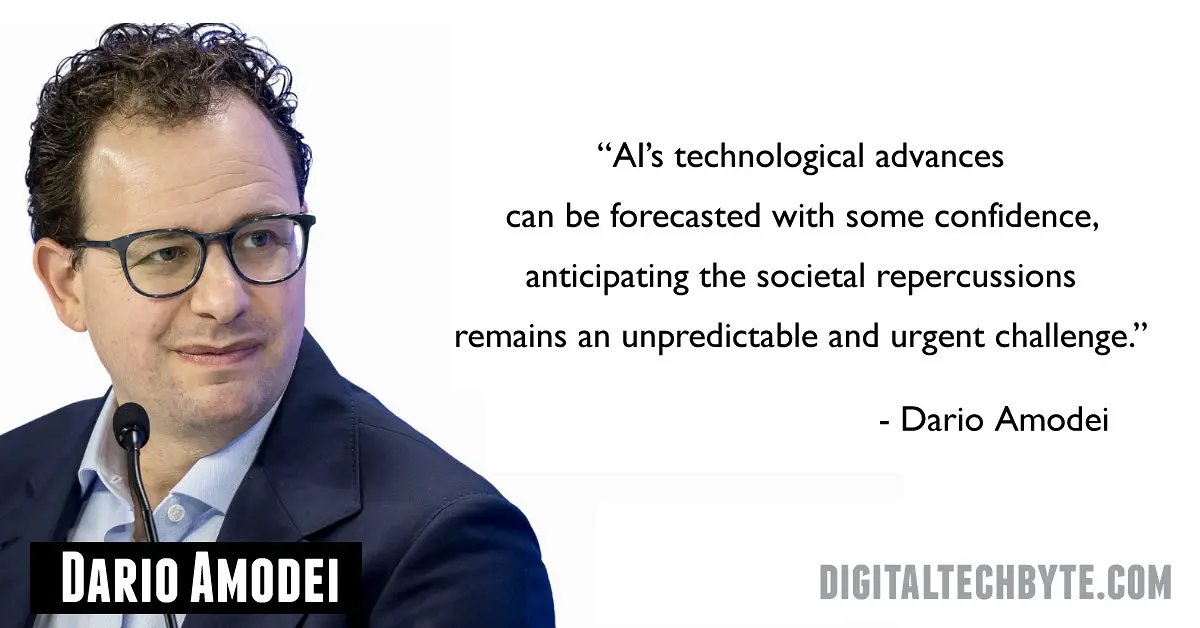
Anthropic’s Dario Amodei stresses that while AI’s technological advances can be forecasted with some confidence, anticipating the societal repercussions remains an unpredictable and urgent challenge.
Dario Amodei, CEO of Anthropic and a leading figure in the artificial intelligence realm, has drawn attention to a critical but often overlooked aspect of AI’s rapid development: the vastly greater difficulty in anticipating how AI will reshape society compared to forecasting its technical progress. His insights underscore the urgent need for broader societal discussions and preparedness as AI continues to advance at an unprecedented clip.
Technical Progress: A Clearer, Though Accelerated, Trajectory
From breakthroughs in neural network architectures to leaps in computational power, the technical roadmap of AI is complex but comparatively trackable. Researchers and engineers follow defined scientific principles, iterating on algorithms, refining models, and pushing hardware limits. Amodei recognizes this pathway as brutally fast and exacting, yet grounded in systematic progress. It is a journey marked by regular releases of increasingly capable models—from GPT-4 through to the much-anticipated GPT-5—and consistent improvements in AI’s ability to understand and generate human-like language, images, and even video.
Societal Impact: A Complex and Uncertain Frontier
Predicting the social consequences of these technologies, however, is a far murkier endeavor. In interviews and public talks over the past months, Amodei has sounded the alarm that disruptions like mass job displacement—particularly within white-collar sectors—could arrive swiftly and with staggering scale.He warns that up to 50% of entry-level white-collar roles might become obsolete within just a few years, posing threats to economic stability and social cohesion that policymakers, corporations, and workers are ill-equipped to handle.
His concerns stretch beyond mere employment shifts. The uneven pace of adaptation among governments, institutions, and individuals means societal infrastructures could strain under pressures AI introduces, from privacy and security challenges to ethical dilemmas. Unlike the predictable march of technology, society’s reaction is nonlinear—dependent on politics, cultural acceptance, and regulatory agility.
The Unpredictability of Human and Institutional Response
Why does this divide exist? Amodei points to the inherently complex nature of human systems. Unlike algorithms, communities and institutions don’t respond instantly or uniformly to change. Educational systems take time to evolve; economic policies require consensus; public awareness lags behind technological breakthroughs. This lag and the diversity of social variables make modeling the societal path of AI a far more tangled problem than the technical one.
Amodei advocates for urgent intervention, calling for enhanced AI literacy across society, clearer public dialogue, and thoughtful regulatory frameworks. He emphasizes that waiting until after major disruptions occur risks entrenching inequality and social unrest. According to him, transparency—particularly from AI developers—and government readiness are essential steps toward harnessing AI’s benefits while mitigating its downsides.
Balancing Optimism With Realism
Despite these warnings, Amodei remains hopeful about AI’s transformative promise—from accelerating medical research to opening new creative and professional frontiers. Yet, his message is clear: the excitement around AI’s capabilities must be matched by sober awareness and strategic preparation for its disruptive societal consequences.
For those who follow AI closely, his stance is a crucial reminder that the future of artificial intelligence is not solely a technological challenge but a broad social experiment with profound implications. It’s a call for balance: advancing innovation while steering its impact thoughtfully.
No crystal ball can capture the full scale of AI’s ripple effects in society, warns Amodei. While we may map the path of its silicon brain, the heart and soul of human systems remain complex, unpredictable, and in urgent need of attention as we move boldly into the AI-driven horizon.