
 Brijesh Desai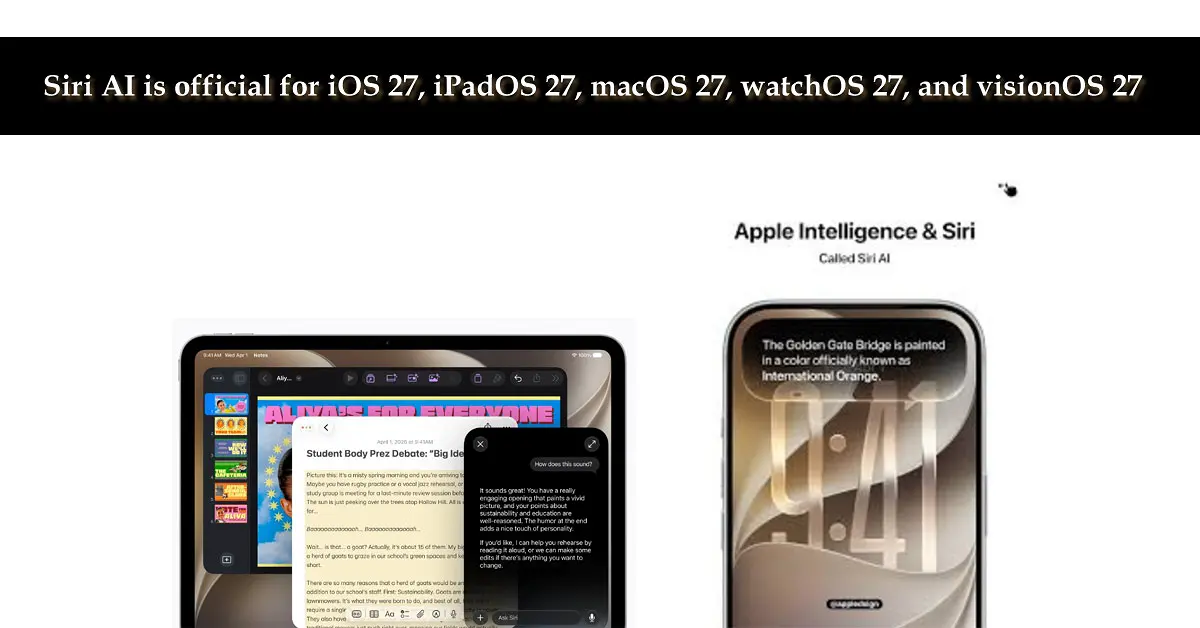
Siri AI Official for iOS 27: Apple announces Siri AI at WWDC 2026 for iOS 27, iPadOS 27, macOS 27, watchOS 27, visionOS 27. New conversational depth, dedicated app, system-wide integration, 3D visualization on visionOS. Beta Fall 2026
Siri AI is officially real, and Apple just announced it at WWDC 2026 on June 7, 2026, marking the most significant Siri upgrade the company has ever done. This revamped assistant spans iOS 27, iPadOS 27, macOS 27, watchOS 27, and visionOS 27, transforming Siri from a basic voice assistant into a genuinely conversational AI agent that can compete with ChatGPT, Claude, and Gemini.
Let’s be honest: Siri hasn’t been great for years. This is Apple finally fixing that.
What Siri AI Actually Does Differently
The changes aren’t cosmetic—they’re fundamental. Here’s what’s new:
This is a chatbot first, voice assistant second. The dedicated Siri app lets users scroll back through prior conversations and kick off new ones, with history synced via iCloud. On macOS, Siri is integrated into Spotlight and available via right-click context menus on any file or window. On visionOS, Siri AI gains a 3D visualization that users can place anywhere in their space.
The Technical Backbone: Apple Intelligence Powers Everything
Siri AI isn’t a standalone product—it’s powered by Apple Intelligence, Apple’s on-device AI framework. This means:
- Privacy-first processing: Most AI runs on your device, not in the cloud
- Better contextual understanding: Siri knows your apps, files, and habits
- Natural language: Less “set alarm for 7 AM,” more “wake me up when it’s sunny tomorrow”
- Image transformation: Next-generation AI to transform images
Apple introducing an overhauled version of Siri in iOS 27, evolving the personal assistant into a more capable chatbot and AI agent able to compete with ChatGPT, Claude, and Gemini.
When Can You Actually Use Siri AI?
Here’s the reality check. Siri AI will launch as a beta in Fall 2026, but it’s only available in the United States and only in English initially.
That’s… restrictive. For a global company, limiting your biggest AI feature to one country and one language is pretty cautious. But Apple’s historically slow with international rollouts, so this is probably just the start.
The beta becomes available this fall (September-October 2026), with full release likely in 2027. iOS 27 itself launches in September 2026 with major Apple Intelligence upgrades, but Siri AI comes as a separate beta update later.
Device Compatibility: You Need Apple Intelligence Hardware
Siri AI requires Apple Intelligence-compatible devices, which means:
- iPhone: iPhone 15 Pro, iPhone 15 Pro Max, iPhone 16 series, and newer
- iPad: iPad Pro with M-series chips, iPad Air with M-series chips
- Mac: Macs with M-series chips (M1 and newer)
- Apple Watch: Ultra 2 and newer models (watchOS 27 support)
- Vision Pro: All Vision Pro models (visionOS 27 support)
Older devices won’t get Siri AI, even if they run iOS 27. Apple Intelligence needs the neural engine and processing power of A17 Pro or M-series chips.
What About the Left-Side Notification Change?
iOS 27 also includes other major changes beyond Siri AI. Notifications will now slide in from the left side of your screen instead of dropping from the top—the same position Apple used for nearly two decades. You’ll also swipe down from the top-left corner for Notification Center, while swiping down on Dynamic Island now opens the new Siri “Search or Ask” interface.
The new “Search or Ask” interface likely requires Apple Intelligence hardware, so it might only work on iPhone 15 Pro and newer models.
Why This Matters for Creators and Professionals
As a tech content creator focused on AI and digital marketing (which I know you are), Siri AI changes how you’ll use Apple devices:
- Voice-to-content workflows: Dictate blog posts, social captions, and emails more naturally
- Cross-device continuity: Start research on iPhone, continue on Mac without repetition
- App automation: Control productivity apps through conversation
- Image editing: Transform images using next-generation AI directly through Siri
- Professional inquiries: Get Siri to research, summarize, and organize information
For social media creators, this means faster content creation through voice commands. For marketers, it means better research workflows. For developers, it means new automation possibilities.
The Competition: Where Does Siri AI Stand?
Apple’s explicitly positioning Siri AI to compete with the big AI chatbots:
- ChatGPT: General knowledge, creative writing, conversation
- Claude: Long-document analysis, ethical AI
- Gemini: Google integration, multi-modal tasks
Siri AI’s advantage is deep Apple ecosystem integration. It knows your apps, files, contacts, and habits because it’s built into the OS. ChatGPT can’t control your iPhone settings. Siri AI can.
The disadvantage is Apple’s restrictive rollout. While ChatGPT and Gemini work globally in multiple languages, Siri AI is US English-only for now.
Privacy: Apple’s Edge Over Competitors
Here’s where Apple wins: on-device processing. Most Siri AI queries run on your device, not in the cloud. This means:
- Your conversations aren’t stored on external servers
- Personal data stays private
- No third-party training on your queries
- Apple Intelligence framework keeps data local
For privacy-conscious professionals, this is a huge advantage over cloud-based chatbots.
Beta Testing: What to Expect
If you grab the beta in Fall 2026:
- Expect bugs: AI features in beta are often incomplete
- Limited functionality: Some features might not work yet
- English-only: No other languages initially
- US-only: Geographic restrictions apply
- Hardware requirements: Need Apple Intelligence devices
The beta will be available through Apple’s developer program first, then public beta shortly after.
Quick Summary
Apple announced Siri AI at WWDC 2026 on June 7, 2026, revamping the assistant into a conversational AI agent competing with ChatGPT, Claude, and Gemini. Siri AI spans iOS 27, iPadOS 27, macOS 27, watchOS 27, and visionOS 27, featuring multi-turn conversations, system-wide integration, a dedicated Siri app with iCloud-synced history, 3D visualization on visionOS, and Mac Spotlight integration. It launches as a beta in Fall 2026, but only in the US and only in English initially. Requires Apple Intelligence hardware (iPhone 15 Pro+, M-series Macs, iPad Pro). Siri AI is powered by Apple Intelligence, meaning privacy-first on-device processing. iOS 27 also includes left-side notifications and Dynamic Island Siri gestures.