
 Brijesh Desai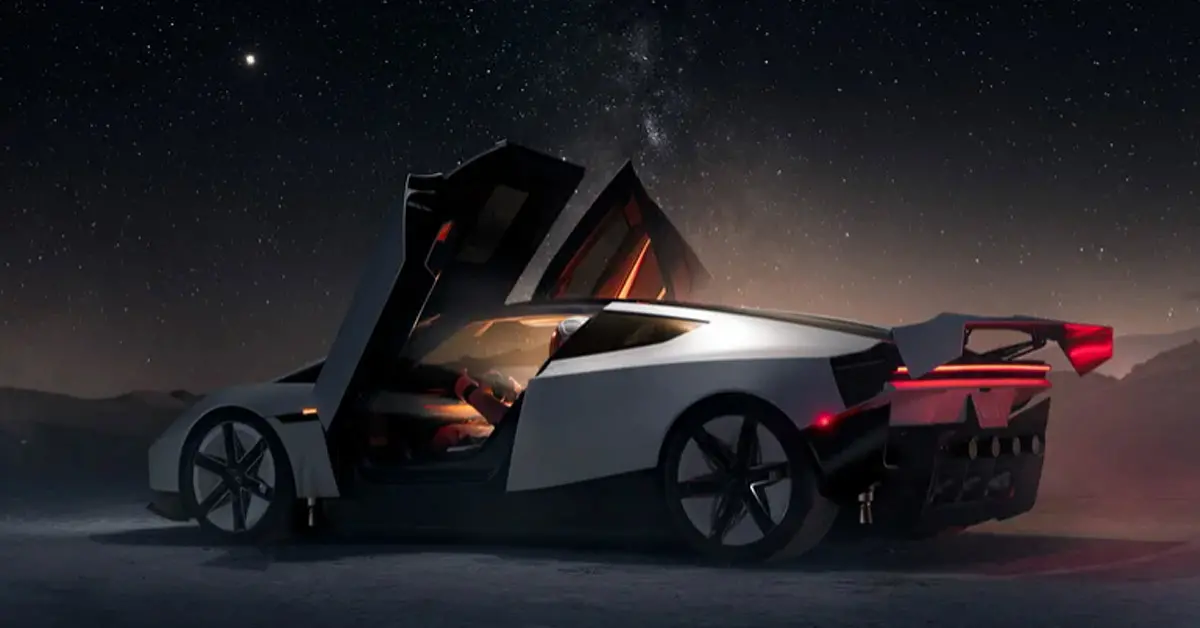
Tesla’s new Roadster can fly, flip and drive upside down. Tesla’s new Roadster did something no normal car can do: it drove upside down, jumped into the air, did a barrel roll, and landed on its wheels using SpaceX‑style cold‑gas thrusters. The demo happened at SpaceX’s test site in McGregor, Texas, on October 15, 2026.
How it flew
The Roadster used two systems:
- Fan suction: A fan system under the car created up to 2 Gs of suction, enough to hold it to a curved ramp and drive upside down.
- Cold‑gas thrusters: Ten thrusters, using compressed nitrogen gas, helped it jump, rotate, and land.
Elon Musk said the car has “attitude control thrusters and main thrusters in the rear,” so it can “basically fly like a rocket.”
The stunt itself
The prototype drove up a huge curved ramp, went fully vertical, then continued upside down at the top. It then launched off the ramp, did a mid‑air barrel roll, and landed safely on all four wheels.
The demo was autonomous, not human‑driven. Musk said that was to “make sure we don’t kill anyone.”
Performance claims
Tesla also claimed the Roadster can do 0–60 mph in 0.81 seconds with the thruster package. That’s faster than any production car has managed.
Price and availability
The standard Roadster starts at $200,000. The version with the suction fan and thruster package—the one that can fly and flip—costs $250,000.
What it means
This is still a prototype, not a production car you can buy tomorrow. But the demo shows Tesla is serious about turning the Roadster into something closer to a rocket‑powered hypercar than a normal EV.
What are the safety and regulatory hurdles
The biggest hurdles are FAA rules for anything that flies, NHTSA rules for anything that drives on public roads, and the fact that Tesla hasn’t shown a clear path to satisfying both at once. Musk himself admitted he’s “not necessarily sure it’s legal in all jurisdictions.”
FAA: the moment it leaves the ground
Under FAA rules, a vehicle is considered an aircraft the moment it’s off the ground—even by a couple of inches. That means the Roadster’s thruster‑assisted jumps and flips would fall under aviation rules, not just automotive ones.
- Airspace clearance: Any flying vehicle over about 250 pounds needs FAA approval and clearance to operate in national airspace.
- Pilot licensing: An owner flying it would likely need a recreational aviation license.
- Flight corridors: Newer FAA rules for eVTOLs require flying cars to follow pre‑approved corridors away from traffic.
- Takeoff and landing: Most states require aircraft to use airports or designated helipads, not public roads.
Tesla got a temporary flight restriction around the McGregor test site for the demo, but that’s a far cry from approval for consumer use.
NHTSA: the road‑car problem
Even if the Roadster only “hops” rather than truly flies, it still has to be street legal as a car.
- No precedent: No production road car has ever shipped with external cold‑gas thrusters.
- Crash safety: High‑pressure gas tanks and thruster deployment in a collision raise new crash‑test questions.
- Pedestrian and noise risk: Thrusters near people on sidewalks or in traffic could pose hearing and safety issues.
- State‑by‑state rules: Vehicle modification and noise laws vary, so approval in one state doesn’t mean approval everywhere.
Tesla hasn’t published detailed safety certifications or crash‑test data for the thruster package.
The “street legal” question
Musk was vague when asked if the flying Roadster would be street legal:
“Depends on your street… I’m not necessarily sure it’s legal in all jurisdictions.”
Experts say that’s the crux: a car like this might be fine on a private track, but making it legal on public roads is a much bigger challenge.
What this means for buyers
For now, the flying Roadster is a demo and track‑only concept, not a car you can legally drive and fly on public roads. The $250,000 “Thrust” version is described as race‑ready, not street‑ready.