
 Brijesh Desai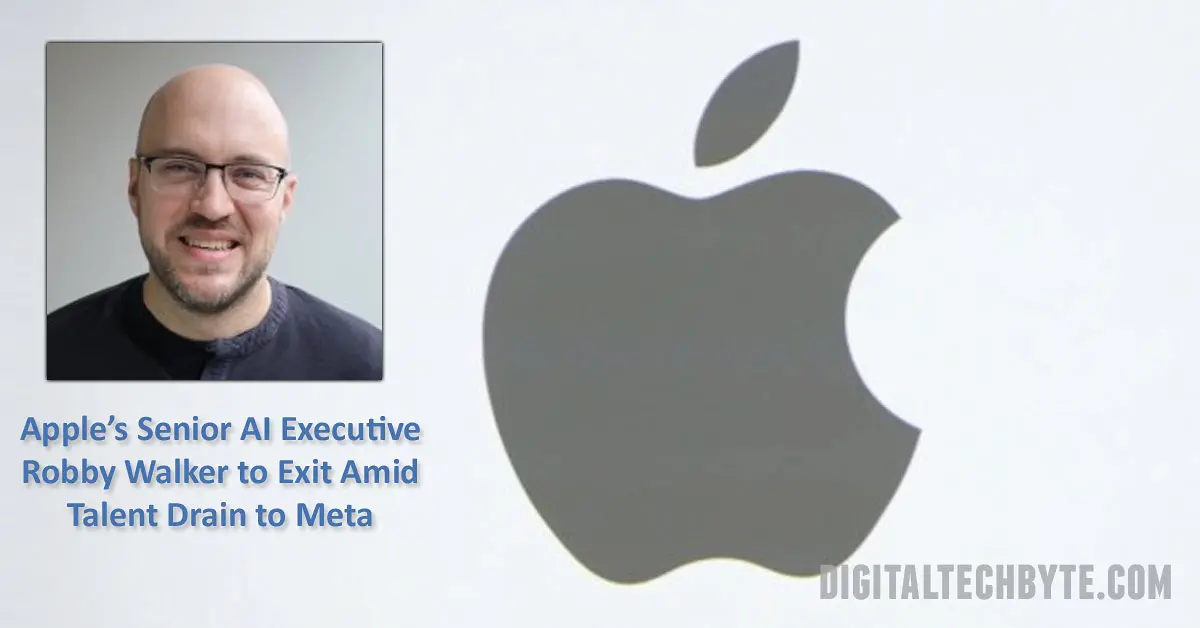
Senior Apple AI executive Robby Walker is set to leave in October 2025, amid a wave of AI talent migrating to Meta. This raises concerns about Apple’s AI strategy and its ability to compete in the growing generative AI space.
Apple is facing a critical juncture in its artificial intelligence strategy with the announced departure of Robby Walker, one of its most senior AI executives. Walker, who has been instrumental in shaping Apple’s AI and voice assistant efforts since joining the company in 2013, is expected to exit in October 2025. This move comes amid growing concerns that Apple is trailing behind peers in the AI arms race and losing key talent to competitors like Meta.
Walker’s Role and Impact at Apple
Throughout his tenure, Walker has helmed pivotal projects, most notably managing Siri’s development until early 2025. His leadership coincided with efforts to revitalize Apple’s voice assistant, which has lagged behind the more conversational and capable AI models from rivals such as Google and OpenAI. Earlier this year, responsibility for Siri was reassigned to Craig Federighi, Apple’s senior vice president of engineering, marking a strategic shift and underscoring the internal challenges in delivering promised advancements.
Beyond Siri, Walker recently led Apple’s team responsible for “Answers, Information, and Knowledge,” working on an ambitious AI-powered web search system designed to compete with ChatGPT and Perplexity. Although this “Apple Intelligence” initiative aims to bolster the company’s AI presence, its launch has been postponed to 2026, reflecting delays in Apple’s AI rollout compared to competitors.
The Wider Context: A Talent Drain to Meta
Walker’s departure is part of a broader pattern of senior AI leaders and engineers leaving Apple. Many have been courted aggressively by Meta, which has expanded its Superintelligence Labs with significant investment and high-profile recruits. Among those who left are Ruoming Pang, former head of Apple’s AI modeling, and Frank Chu, Apple’s former engineering director, both now contributing to Meta’s AI ambitions.
This exodus raises serious questions about Apple’s strategic position in AI development, especially as it faces pressure to bridge the gap with companies advancing rapidly in generative AI capabilities. Apple’s notably cautious rollout and recent product launches haven’t showcased significant AI innovation, intensifying scrutiny of its future roadmap.
Industry Implications and Outlook
Apple’s challenges highlight the fiercely competitive environment within AI, where lead times matter greatly and talent is a premium. The loss of an executive like Robby Walker, deeply familiar with Apple’s AI infrastructure and vision, may slow progress or necessitate strategic pivots. Analysts speculate whether Apple might pursue acquisitions or reconsider leadership roles to regain momentum.
Still, Apple remains financially robust, with the cash reserves and market position to accelerate its AI endeavors if it so chooses. The upcoming unveiling of Apple’s AI-powered search and knowledge products will be closely watched, as the company seeks to prove it can innovate effectively and retain top-tier AI talent in a market that is evolving at breakneck speed.