
 Brijesh Desai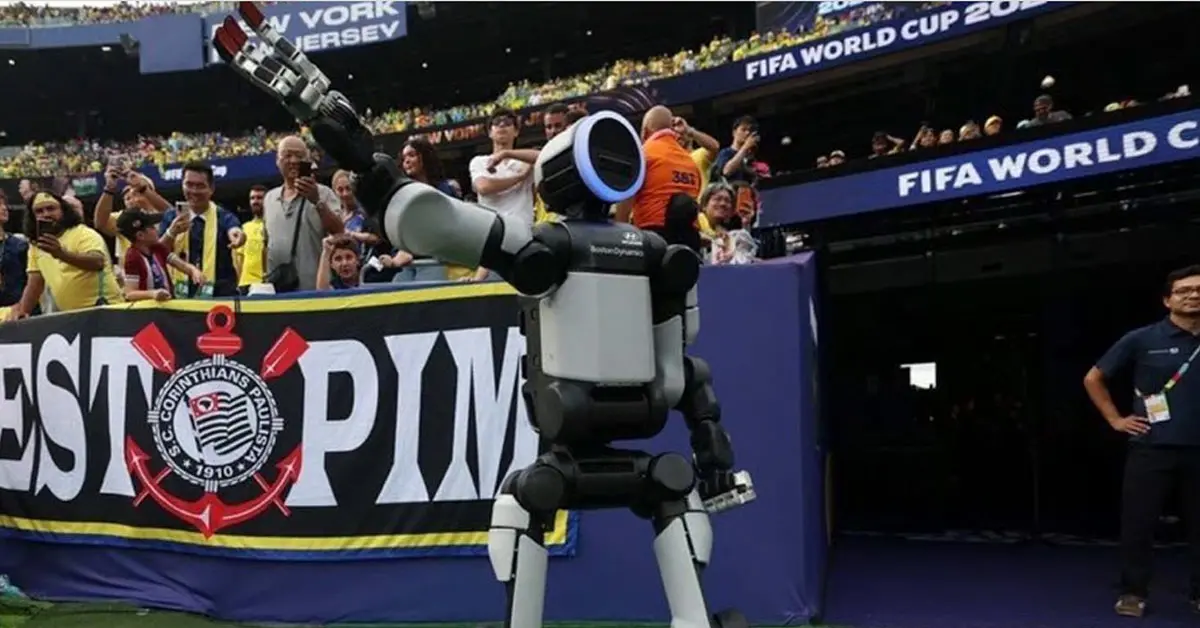
Hyundai Atlas humanoid robot made headlines at FIFA World Cup 2026 with a live halftime debut, showcasing robotics, AI, and future mobility in a bold global moment.
Hyundai Atlas humanoid robot makes a striking FIFA World Cup 2026 debut
Hyundai Atlas humanoid robot took center stage at the FIFA World Cup 2026 in a moment that blended sport, spectacle, and advanced robotics in a way few brands could pull off. What might have looked like a flashy halftime stunt was actually a carefully staged demonstration of how far humanoid robotics has come—and how aggressively Hyundai wants to position itself in that future.
The live activation placed Boston Dynamics’ Atlas in front of a global audience, underscoring Hyundai Motor Group’s effort to turn robotics from a lab-bound concept into something visible, emotional, and commercially relevant. Hyundai said the performance was the first public demonstration of Atlas’s real-world movement capabilities in a live match environment, and the first time a humanoid robot had been integrated into a FIFA World Cup match setting.
What happened at the match
During halftime, Atlas emerged from the player tunnel and performed football-inspired goal celebrations before delivering the ceremonial match ball to the referee. The routine drew on movements associated with well-known players, including Harry Kane, Erling Haaland, Matheus Cunha, and Son Heung-min, according to Hyundai’s release.
That matters because the company was not simply showing off a robot that can walk or wave. It was demonstrating balance, fluid motion, and controlled adaptation in a live, high-pressure environment where timing and reliability matter just as much as spectacle. In a stadium packed with emotion and noise, that kind of precision is as much a technical milestone as it is a marketing win.
Why Hyundai is doing this
Hyundai has been building a broader robotics narrative around its “Next Starts Now” World Cup platform, and Atlas is the most visible symbol of that strategy so far. Earlier in the campaign, Hyundai launched “School of Football,” a five-part social film series showing Atlas learning football-like movements through observation, repetition, and reinforcement learning.
The company says that approach reflects its “Progress for Humanity” philosophy: making advanced robotics feel more human-centered, accessible, and emotionally resonant. That framing is important because Hyundai is not just selling an image of the future; it is also signaling where it believes future manufacturing and mobility are heading.
The tech behind the show
Hyundai said Atlas’s halftime performance relied on three core capabilities: retargeting technology, reinforcement learning, and whole-body control. Retargeting allows the robot to adapt human motion to its own form, reinforcement learning helps it improve through simulations, and whole-body control coordinates movement across its frame for balance and coordination.
Boston Dynamics’ robotics chief Alberto Rodriguez said the company has long used human athletic movements such as gymnastics, dancing, and parkour to push the boundaries of what robots can do. He added that the World Cup collaboration helps show how those same skills can support practical industrial applications in the real world.
Why it matters now
This debut lands at a time when humanoid robotics is becoming one of the hottest arenas in AI and industrial innovation. Hyundai has also signaled plans to train Atlas for factory use at its Robot Metaplant Application Center in Georgia, linking the World Cup showcase to a much larger manufacturing ambition.
In other words, the robot on the pitch is not just a branding exercise. It is a preview of how companies are trying to normalize humanoid machines in everyday environments—from entertainment and logistics to production lines and beyond.
Hyundai Atlas humanoid robot may have made its most memorable appearance yet on football’s biggest stage, but the real story is bigger than one halftime moment. It’s about where robotics is going, who gets to see it, and how quickly the future is starting to feel less theoretical and a lot more real.
Summary: Hyundai used the World Cup to showcase Atlas as both a robotics breakthrough and a public symbol of its future mobility strategy.